Introduction
Trauma does not simply end with the individual who experiences it. Research increasingly demonstrates that the effects of traumatic experiences can ripple across generations, shaping family dynamics, coping patterns, and even biological responses to stress. Yet alongside this transmission of trauma, families also pass down remarkable capacities for resilience, healing, and cultural strength.
For mental health practitioners working with trauma survivors, understanding these multigenerational patterns is essential. The Transgenerational Trauma and Resilience Genogram (TTRG), developed by Rachael D. Goodman in 2013, offers a powerful framework for visualizing and addressing both trauma and resilience across family generations.
"While trauma might be conveyed from parent to child, coping strategies, ways of overcoming traumatic stress, and ways of sustaining one's culture despite oppression may also be passed down." — Goodman (2013, p. 389)
This article explores the TTRG methodology, its theoretical foundations, and practical applications for clinicians seeking to integrate trauma-informed, strengths-based approaches into their genogram practice.
Understanding Transgenerational Trauma
What Is Transgenerational Trauma?
According to Goodman (2013), transgenerational trauma occurs when the effects of trauma are conveyed across generations within families and communities. This phenomenon has been documented across diverse populations, including Holocaust survivors and their descendants, Indigenous communities affected by colonization, and families impacted by war, displacement, and systemic oppression.
Trauma transmission operates through multiple pathways, including:
- Behavioral patterns: Children learning anxious or avoidant behaviors from traumatized parents
- Attachment disruptions: Trauma affecting caregiving capacity and parent-child bonding
- Family communication patterns: What Danieli (2007, as cited in Goodman, 2013) calls the "conspiracy of silence"—families not discussing past trauma to protect future generations
- Cultural and community effects: Collective trauma affecting entire groups, such as what Native communities describe as "soul wound" (Goodman, 2013)
Beyond Individual Trauma: An Ecosystemic Perspective
Traditional trauma assessment often focuses narrowly on individual experiences. However, Goodman (2013) argues that this approach misses crucial contextual factors. Drawing on Bronfenbrenner's (1977) ecological model, the TTRG incorporates a broader understanding of how trauma operates across multiple systems.
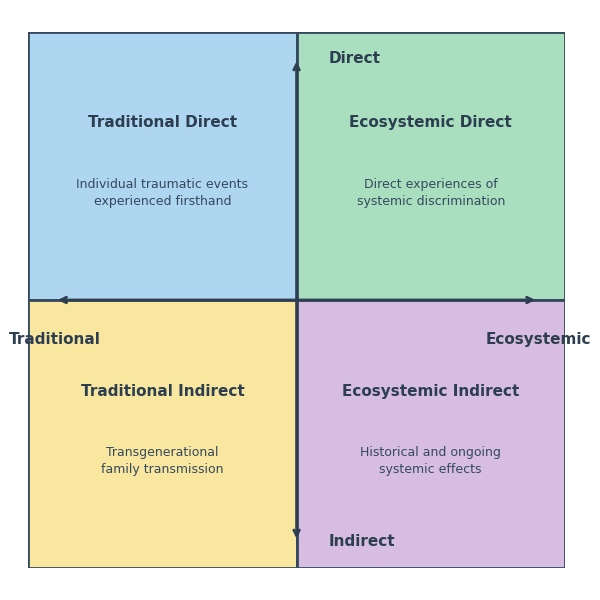
Goodman (2013) proposes a four-quadrant conceptualization of trauma that distinguishes between traditional and ecosystemic sources:
- Traditional direct trauma: Traumatic events experienced directly by the individual
- Traditional indirect trauma: Transgenerational transmission within families
- Ecosystemic direct trauma: Direct experiences of systemic oppression (e.g., racism, discrimination)
- Ecosystemic indirect trauma: Transgenerational effects of historical and ongoing systemic oppression
This framework recognizes that trauma can stem not only from discrete events but also from ongoing experiences of marginalization, discrimination, and cultural disruption.
The Transgenerational Trauma and Resilience Genogram
What Makes the TTRG Different?
According to Goodman (2013), the TTRG combines the traditional genogram structure developed by McGoldrick and colleagues with an overlay based on Bronfenbrenner's ecological model. Visually, this means adding concentric circles to the familiar family diagram, allowing clinicians to map both family relationships and broader systemic influences.
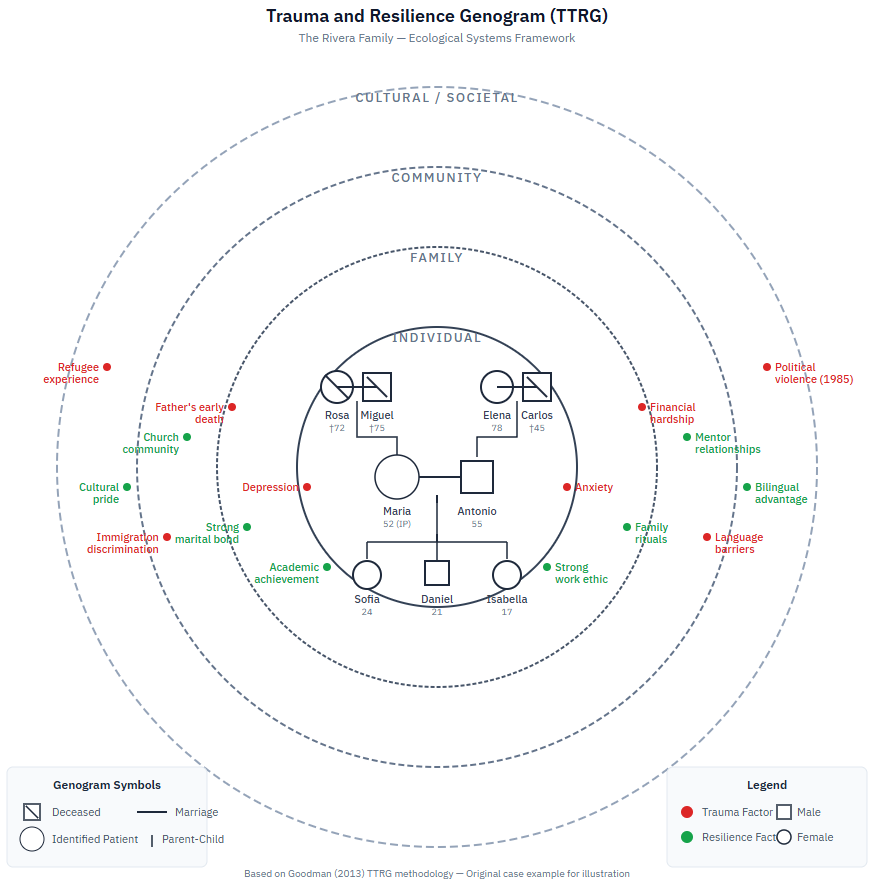
"The Transgenerational Trauma and Resilience Genogram (TTRG) was created as a dynamic tool that can assist practitioners in conducting comprehensive trauma assessment and intervention." — Goodman (2013, p. 387)
Four Guiding Principles
The TTRG is distinguished from traditional genograms by four foundational principles (Goodman, 2013):
1. Comprehensive/Ecosystemic Understanding of Trauma
Rather than focusing solely on individual traumatic events, the TTRG considers trauma within its full ecological context. This includes family patterns, community factors, cultural experiences, and systemic influences such as racism, poverty, and historical oppression.
2. Strengths-Based Focus
A defining feature of the TTRG is its emphasis on resilience alongside trauma. The tool explicitly identifies coping strategies, support systems, cultural strengths, and protective factors that have helped family members survive and thrive despite adversity.
3. Cultural Responsiveness
"The TTRG is culturally responsive in that it is client-directed and reflects the personal, familial, cultural, and communal experiences of the client" (Goodman, 2013, p. 393). The approach honors diverse definitions of family, community, and healing practices. For more on integrating culture into genogram practice, see our article on the cultural lens in family assessment.
4. Social Justice/Critical-Liberatory Perspective
The TTRG attends to power dynamics, systemic oppression, and social justice considerations. It acknowledges that many sources of trauma—including racism, colonization, and economic marginalization—are not merely individual experiences but systemic realities requiring systemic understanding.
Creating a Transgenerational Trauma and Resilience Genogram
The Collaborative Process
Goodman (2013) emphasizes that the TTRG should be developed collaboratively between client and counselor. This approach honors the client's expertise about their own family and cultural context, strengthens the therapeutic alliance, and ensures the genogram accurately reflects the client's lived experience.
Key Assessment Questions
Goodman (2013) recommends several guiding questions for TTRG development:
Comprehensive trauma assessment:
- "What events have occurred in your life (or your family or community) that have been very stressful or traumatic?"
- What patterns of difficulty or challenge appear across generations?
- What systemic factors (discrimination, poverty, displacement) have affected your family?
Strengths-based inquiry:
- "What are your strengths? How have you maintained your strengths in the face of these stressors?"
- What coping strategies have worked for family members in the past?
- Who are the sources of support within and outside the family?
Cultural responsiveness:
- "When someone in your family or community is upset, what do they do?"
- What cultural practices, spiritual beliefs, or community connections have provided strength?
- How does your family define healing and wellness?
Visual Organization
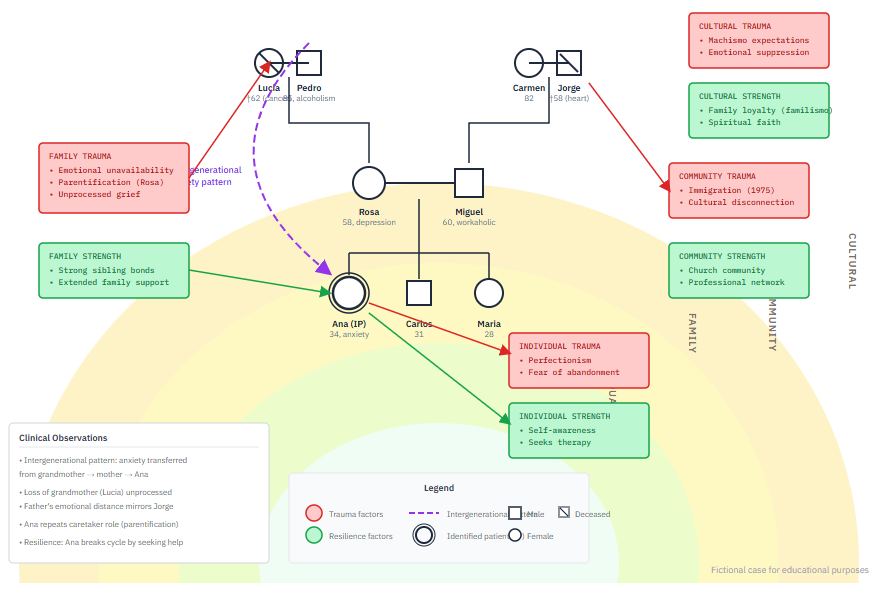
Goodman (2013) describes the spatial logic of the TTRG: factors that directly impact the client are placed closer to the center of the diagram, while more distant influences occupy outer rings. This organization helps clinicians and clients visualize how various factors relate to the client's experience.
Clinical Applications
Individual Trauma Counseling
The TTRG provides a structured framework for comprehensive trauma assessment that goes beyond identifying symptoms to understanding their origins and context. By mapping trauma across generations, clinicians can help clients recognize that their struggles often have roots extending far beyond their individual experience.
Family Therapy
For families who have experienced collective trauma—such as refugee families, families affected by addiction, or those dealing with intergenerational abuse—the TTRG offers a way to visualize shared patterns while also identifying family strengths and potential pathways to healing.
Breaking the Conspiracy of Silence
One powerful application of the TTRG is its capacity to open conversations about trauma that families may have avoided discussing. The visual, structured format can make it safer to explore difficult topics, helping families move from silence to dialogue about their shared history.
As Joseph et al. (2023) note in their literature review, "In the trauma counselling setting a genogram can be utilised by the practitioner to support an understanding of the client's broader ecosystem, promoting the inherent strengths and systemic support of clients who have experienced trauma" (p. 25).
Practical Considerations for Clinicians
Time and Pacing
The comprehensive nature of the TTRG means it typically requires more time than a standard genogram. Goodman (2013) suggests that clinicians may need to assign homework or spread the process across multiple sessions. This gradual approach can actually be therapeutically beneficial, allowing clients time to process and reflect between sessions.
Counselor Preparation
Goodman (2013) notes that effective use of the TTRG requires counselors to develop awareness of sociopolitical histories affecting their client populations. Additionally, clinicians should:
- Examine their own cultural assumptions and potential biases
- Build competence in trauma-informed care
- Understand systemic factors such as racism, colonization, and structural inequality
Balancing Trauma and Resilience
While exploring trauma history, clinicians should consistently attend to resilience factors. This dual focus prevents the assessment from becoming overwhelming and helps clients recognize their inherent strengths and resources.
Conclusion
The Transgenerational Trauma and Resilience Genogram represents a significant evolution in genogram practice, offering clinicians a comprehensive framework for trauma assessment that honors both the weight of intergenerational suffering and the remarkable capacity of families to survive, adapt, and heal.
By integrating ecological systems theory with traditional genogram methodology, the TTRG provides a way to visualize trauma and resilience in their full complexity. Its four guiding principles—comprehensive understanding, strengths focus, cultural responsiveness, and social justice awareness—offer a roadmap for trauma-informed, culturally humble practice.
For mental health professionals working with trauma survivors, the TTRG is more than an assessment tool. It is an invitation to bear witness to multigenerational patterns of both suffering and strength, and to support clients in writing new chapters in their family's ongoing story of resilience.
References
Amorin-Woods, D. (2024). Genograms, culture, love and sisterhood: A conversation with Monica McGoldrick. Australian and New Zealand Journal of Family Therapy, 45(3), 349–366. https://doi.org/10.1002/anzf.1602
Bronfenbrenner, U. (1977). Toward an experimental ecology of human development. American Psychologist, 32(7), 513–531.
Goodman, R. D. (2013). The transgenerational trauma and resilience genogram. Counselling Psychology Quarterly, 26(3-4), 386–405. https://doi.org/10.1080/09515070.2013.820172
Joseph, B., Dickenson, S., McCall, A., & Roga, E. (2023). Exploring the therapeutic effectiveness of genograms in family therapy: A literature review. The Family Journal: Counseling and Therapy for Couples and Families, 31(1), 21–30. https://doi.org/10.1177/10664807221104133
McGoldrick, M., Gerson, R., & Petry, S. (2008). Genograms: Assessment and intervention (3rd ed.). W. W. Norton.
Build Your Genograms with WebGeno
Create professional multigenerational family diagrams with our intuitive web-based tool. Document relationships, health conditions, and family patterns.
Try WebGeno Free